


Objective:
We aim to characterize and map the different regimes in immiscible two-phase flow. Our work will link spatial scaling behavior, characteristic length scales, and burst dynamics in two-phase flow to the broader problem of upscaling. Furthermore, we will clarify the role of film flow in immiscible two-phase flow.
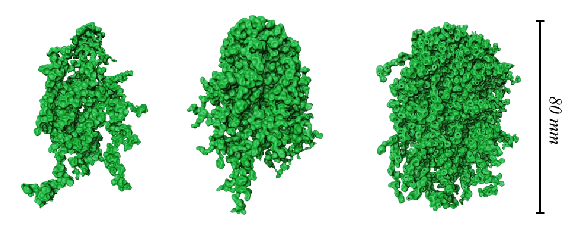
Images from a 3D optical scanner show glycerol invading a less viscous rapeseed oil at flow rates of Q = 0.1, 0.5, and 1.0 ml/min (left to right). The resulting structures consist of a compact displacement region surrounded by thin “fingers.”
Description:
One of the central challenges in porous media science is the enormous range of length scales. Hydrocarbon reservoirs and aquifers span kilometers, whereas pore diameters range from tens to hundreds of micrometers—over seven orders of magnitude smaller. This raises a fundamental question: How can large-scale flow behavior be inferred from pore-scale physics?
The structure and dynamics of drainage in porous media depend on numerous parameters, including fluid densities and viscosities, surface tension, wetting characteristics, and the geometry of the porous network. Viscous, gravitational, and capillary forces dominate at different scales, and their interactions give rise to distinct flow regimes.
Our experimental program adopts a bottom-up approach to investigate the scaling of flow structures across these regimes, as well as the characteristic length scales that define the crossovers between them. We measure capillary pressure fluctuations and Haines jumps, and analyze how these fluctuations relate to energy dissipation at larger scales.
Experiments will be conducted using both quasi-two-dimensional and fully three-dimensional model systems. The quasi-2D systems include glass-bead models and 3D-printed transparent models that allow precise control of local geometry. For 3D experiments, we have developed an optical scanner based on refractive-index matching and fluorescence imaging.
Deliverables
- Develop a theory for upscaling based on spatial scaling behavior and characteristic length scales across flow regimes, and explain how burst activity relates to surface energy and dissipation.
- Use experimental results on film flow to calibrate a network model that includes film transport.
- Determine the relaxation properties and characteristic length scales of two-phas flow in porous media.
- Provide a detailed mapping and description of the different two-phase flow regimes.
- Deliver a state-of-the-art 3D optical scanner.
Investigators
Principal Investigator for Research Theme 3: Professor Knut Jørgen Måløy.
Partners:
Eirik Grude Flekkøy, Alex Hansen, Bjørnar Sandnes, Stéphane Santucci, Mickael Bourgoin, Ole Torsæter, Carl Fredrik Berg, Renaud Toussaint, Gerhard Schäfer, Per Arne Rikvold, Signe Kjelstrup
Postdoctoral Fellows and Researchers: Marcel Moura, Fredrik Kvalheim Eriksen, Mihailo Jankov, Antoine Turquet, Antoine Dop, Paula Reis.
PhD students: Joachim Falck Brodin, Louison Thorens, Monem Ayaz, Maud Viallet
Selected articles:
- Reis, P., and Måløy, K. J. Drainage front width in a three-dimensional random porous medium under gravitational and capillary effects, Rev. Research 7, 033244, (2025), DOI: https://doi.org/10.1103/5bbz-ksds
- Brodin, J. F, Pierce, K., Reis, P., Rikvold, P.A, Moura, M., Jankov M., and Måløy, K.J., Interface instability of two-phase flow in three-dimensional porous medium. Accepted in Phys. Rev Fluids (2025). DOI: https://doi.org/10.1103/hm82-167x
- Khobaib, K., Reis, P., Moura, P., Toussaint R., Flekkøy, E.G., and Måløy, K.J. Gravity Stabilized Drainage in Porous Media with Controlled Disorder. Rev. Research , 7, 023040 (2025). DOI: 10.1103/PhysRevResearch.7.023040
- Brodin, J. F., Rikvold, P. A., Moura, M., Toussaint, R., & Måløy, K. J. Competing gravitational and viscous effects in 3D two-phase flow investigated with a table-top optical scanner. Frontiers in Physics (2022).
- Eriksen, F. K., Moura, M., Jankov, M., Turquet, A., & Måløy, K. J. The transition from viscous fingers to compact displacement during unstable drainage in porous media. Physical Review Fluids, 7, 013901 (2022).
- Måløy, K. J., Moura, M., Hansen, A., Flekkøy, E. G., & Toussaint, R. Burst Dynamics, Upscaling and Dissipation of Slow Drainage in Porous Media. Frontiers in Physics, 9:796019 (2021).
- Thorens, L., Måløy, K. J., Bourgoin, M., & Santucci, S. Magnetic Janssen Effect. Nature Communications, 12:2486 (2021).
- Ayaz, M., Toussaint, R., Schäfer, G., & Måløy, K. J. Gravitational and finite-size effects on pressure–saturation curves during drainage. Water Resources Research, 56, e2019WR026279 (2020).
- Moura, M., Flekkøy, E. G., Måløy, K. J., Schäfer, G., & Toussaint, R. Connectivity enhancement due to film flow in porous media. Physical Review Fluids 4, 094192 (2019).
- Moura, M., Måløy, K. J., Flekkøy, E. G., & Toussaint, R. Verification of dynamic scaling for the pair correlation function during slow drainage of a porous medium. Physical Review Letters, 119, 154503 (2017).