


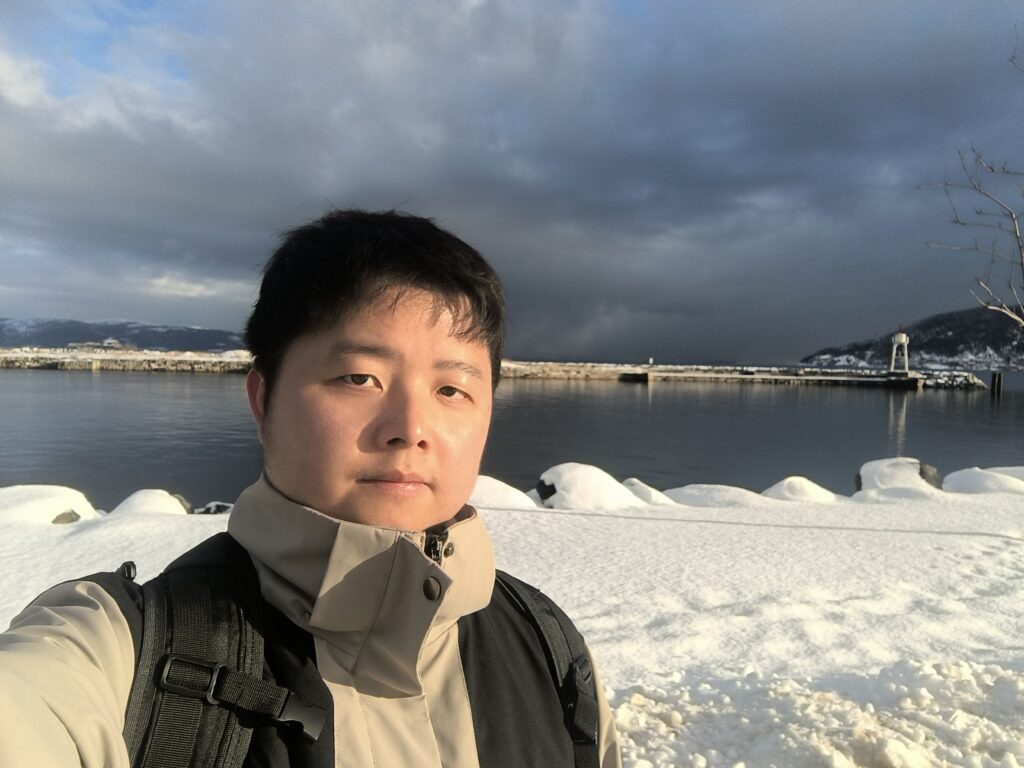
Zhengwei Cheng joined PoreLab on January 19, 2026, as a PhD candidate on a three-year contract. He is the second PhD student to be recruited under Alex Hansen’s ERC (European Research Council) Advanced Grant project, AGIPORE – A Statistical Mechanics Framework for Immiscible Two-Phase Flow in Porous Media.
The ERC Advanced Grant is a prestigious funding scheme awarded by the European Union to support leading, established researchers in carrying out high-risk, high-reward projects across all scientific fields.
Zhengwei hold a master degree in physics from Shaanxi Normal University in China from June 2023, and a bachelor degree in science from Lanzhou University in China from 2019. Zhengwei spent 4 months as teaching assistant in electrodynamics at Shaanxi Normal University.
His main supervisor is Professor Alex Hansen and his co-supervisor is Dr. Santanu Sinha
Zhengwei presents his PhD topic as follows:
This PhD project is associated with WP2 of the ERC Advanced Grant AGIPORE. The goal of AGIPORE is to create a set of equations describing immiscible two-phase flow in porous media on the Darcy scale, i.e., the scale at which the porous medium appears continuous but small enough so that it is homogeneous. It is based on the Jaynes generalized statistical mechanics and the ensuing equations have the same mathematical structure as thermodynamics. A key concept in the theory is agiture which plays the same role as temperature in ordinary thermodynamics. In the laboratory, the variables that describe the flow are the fluid velocities, the saturation (how much there is of each fluid in pore space) and the pressure gradient. Somehow the pressure gradient must be associated with the agiture. Intuitively it acts as a temperature in that the flow becomes increasingly disordered with increasing pressure gradient. Furthermore, under steady-state flow conditions, the pressure gradient is a constant field. The problem is that the pressure gradient is a vector, while the agiture is a scalar. Through a simple symmetry argument, Hansen and Sinha have argued that the agiture is the absolute value of the pressure gradient, |∇p|. The first task of the PhD project is to investigate the relation between agiture and pressure gradient, finding out what it really is and placing this on a solid footing. A second emergent variable in the theory is the “flow derivative” which has a vague relation to chemical potential in ordinary thermodynamics. There are reasons to believe from the theory that also this variable forms a constant field under steady-state flow conditions. Also this part of the theory needs strengthening. PhD student Mohammed Taleghani, supervised by Antje van der Net and Carl Fredrik Berg from the NTNU Geosciences Department and Alex Hansen from IFY, is measuring this quantity computationally and will move to experiments shortly. It is therefore natural with a collaboration on this point.
Recently, Sinha, Carmona, Andrade and Hansen have studied the phase diagram of immiscible two-phase flow using a technique called Boltzmann machine learning. Part of this technique is to use the Jaynes maximum entropy principle, which is also central to his generalized statistical mechanics. There is a relation between the Boltzmann machine learning technique and the upscaling theory of Hansen and coworkers. This opens up for constructing a pore-scale Hamiltonian for the upscaling theory. This part of the PhD project will tie nicely in with a starting collaboration between Steffen Berg (professor II, IFY), Daan Frenkel (permanent visitor to IFY), Alex Hansen, Sandipan Mohanty (KFA, Jülich), and Santanu Sinha on exploring further the Boltzmann machine learning technique for immiscible two-phase flow using the D-Wave quantum annealing computer at KFA.