


The article by Vegard Jervell and Øivind Wilhelmsen on coupling residual entropy scaling to revised Enskog theory (REST) was selected as Editor’s Pick in The Journal of Chemical Physics. The article is titled: Coupling residual entropy scaling and revised Enskog theory (REST): A predictive framework for multicomponent transport properties from dilute gas to dense liquid
Residual entropy scaling (RES) is a framework for modelling transport properties that has gained significant traction in recent years. This framework leverages the fact that transport properties like viscosity and thermal conductivity, when properly scaled, behave as univariate functions of the residual entropy of a system. The form of this function has commonly been determined via experiments or simulations, and RES has proven a powerful correlation tool, especially when few data points are available. Despite its recent increase in popularity, RES suffers from the fact that the functional form of the scaled transport properties is not known a priori.
Simultaneously, developments in recent years have made revised Enskog theory (RET) applicable to a range of real pure fluids and mixtures. RET is based on first principles, and requires no other input than the molecular interaction potential in order to provide predictions of the transport properties. However, RET becomes inaccurate for cold, sub-critical liquids, which are highly structured.
By combining RES with RET we have developed the REST method: RET is used at high temperatures to determine the functional form of the scaled transport properties in residual entropy space. This function can then be extrapolated into the highly structured liquid regime to predict the transport properties of liquid mixtures. Since RET is fully predictive, REST does not rely on any experimental measurements in order to make predictions. Furthermore, REST is applicable to the full fluid regime, from dilute gas to liquid near the triple point.
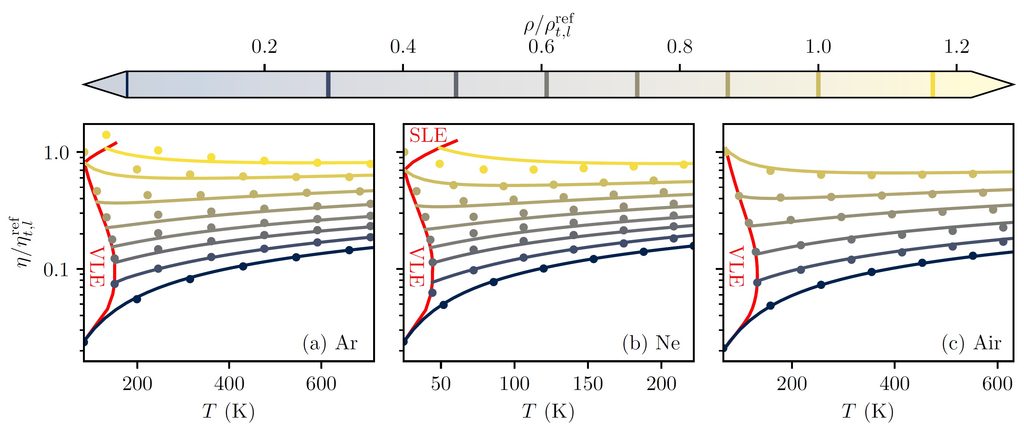
Figure 1 : The viscosity of neon (a), argon (b), and air (c), from the dilute-gas region to near the triple point, predicted with REST (lines) and obtained from the reference equations (marks).
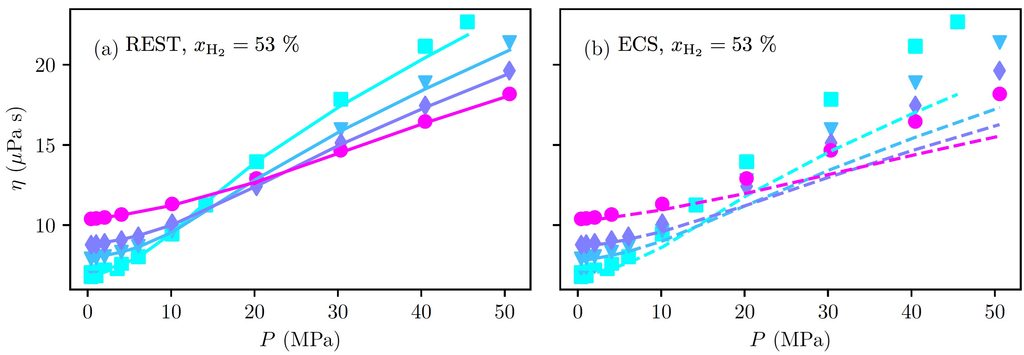
Figure 2 : The viscosity of a hydrogen/methane mixture predicted with REST (solid lines, left) and the industry-standard ECS method used in REFPROP (dashed lines, right), compared to experimental measurements (marks)
Recommended reading:
Vegard G. Jervell, Øivind Wilhelmsen: Coupling residual entropy scaling and revised Enskog theory (REST): A predictive framework for multicomponent transport properties from dilute gas to dense liquid. 1 October 2026. The Journal of Chemical Physics. https://doi.org/10.1063/5.0347005
Contact: Vegard G.Jervell vegard.g.jervell@thermophys.com
.